
Why I started Ontoly.
Hello to everyone who has cheered us on, asked us hard questions, or quietly wondered what Ontoly actually does.
I’m Ashley Sarauer, founder and CEO of Ontoly. This is the first time I’ve written down, publicly, why Ontoly exists. It’s been a long time coming. Two years, give or take, which in startup years is roughly a decade.
Here’s the short version. To reach net zero by 2050, we need to electrify as many buildings as we can, and that’s expensive. Ontoly connects real building decarbonization projects with carbon finance from buyers around the world. Think of us as professional recyclers of climate money: our job is to make sure it lands on the most credible projects. Every credit we certify traces back to one specific building, the specific equipment installed, and real utility data from before and after the retrofit.
The long version involves a knee. I’ll get there.
Buildings and construction account for around 37% of global CO₂ emissions.[1]
Here’s the good news: we don’t need a miracle invention. The International Energy Agency’s net zero roadmap relies mainly on technology that’s already on the market for buildings, with high-efficiency electric heat pumps as the main way to heat them.[2]
Here’s the bad news: the bill. A heat pump costs more upfront than another gas boiler, often with electrical upgrades on top, and the IEA calls high upfront cost a major barrier to adoption.[3] So building decarbonization crawls. In advanced economies, fewer than 2% of buildings are retrofitted each year. The IEA’s net zero pathway needs 2.5%, every year, from 2030.[4]
So the hard question isn’t “do we know how?” It’s “who pays, and how fast?” That’s a retrofit financing problem. And financing problems happen to be my favourite kind.
Carbon credits can change the math for building owners. When a retrofit cuts emissions, the owner can turn those reductions into carbon credits and sell them, either after the results are measured (retrofits completed within the past two years can still qualify) or before the project breaks ground, through a pre-purchase agreement with a buyer.
We’ve modelled this across several building archetypes and net zero scenarios. At a carbon price of $150 a tonne, carbon revenue can cover up to 40% of the capital cost of a full electrification retrofit.
Does $150 sound high for a carbon credit? Fair question. Premium carbon removal credits like biochar already trade at around that price.[5] And it’s still well below what cities with building performance standards charge for every tonne a building emits over its limit: $234 in Boston[6] and $268 in New York.[7]
I’m an environmental economist by training. I believe markets are one of the most powerful levers we have for lining up incentives with values, in the economy we actually live in. I have, on occasion, explained this at dinner parties for longer than anyone asked.
I spent years designing climate policy for two governments. In Alberta, I worked on the Technology Innovation and Emissions Reduction (TIER) Regulation, the industrial carbon pricing system that sets the rules for the province’s largest emitters.[8] In British Columbia, I supported local government climate action and, for a time, led the Provincial Emissions Inventory. Then I joined the leading registry in the voluntary carbon market and learned how carbon credits get certified, end to end.
It was good, important work. It was also a lot of chipping away. And the same gap kept showing up: buildings are one of the largest sources of emissions on the planet, yet there was no carbon credit designed around how buildings actually work.
To me, emissions reductions from real building retrofits are the most credible climate solution out there. The baseline is real: a building’s own utility bills from the years before the retrofit, not a hypothetical counterfactual. And the reductions don’t reverse: a tonne a building never emits can’t be un-emitted later.
There’s a built-in check, too. Swapping an old gas boiler for a new one is the cheaper choice, but the building keeps burning gas. A heat pump costs more upfront.[3] So meaningful reductions only show up in the data when an owner pays for the low-carbon option and actually installs it.
So I kept asking myself: why can’t I just buy a carbon credit that helps pay for a real retrofit?
I spent a year asking that question to anyone at a conference wearing a lanyard. Almost everyone agreed with me. Which was encouraging, and also a little suspicious. If everyone agreed, why didn’t it exist?
I had a few realizations while working as an integrity lead at the leading carbon registry, where most of my days were spent reading project documents line by line. The first: when you’re selling an invisible asset for real dollars, you’d better be damn sure you’ve checked every number you can. The second: where a number comes from matters just as much as the number itself. The third took me longer to see: buildings needed a system built around them.
Most carbon registries were designed for big projects like forests, landfills and cookstove programmes, where certifying at the project or programme level makes sense. Apply that same approach to buildings, though, and you get a data granularity problem. Hundreds of buildings can be rolled into one project, and the results lean on averages and models rather than what each building actually did.
Buildings are too different for averages. Ask a retrofit engineer whether every building is basically the same and you’ll get a look I can only describe as professional pity. Each one has its own age, its own grid, its own heating and cooling equipment, its own leaky windows. Take two heat pump projects. A 100-unit apartment building in Massachusetts cut about 130 tonnes of CO₂ a year.[9] A hospital in Shrewsbury, England, expects to cut more than 3,000.[10] That’s more than a twenty-fold difference from the same core technology. Average those together and the tonnes stop pointing to anything real.
Models can be badly off, too. A large randomized study of more than 30,000 US households in a home weatherization program found that engineering models projected energy savings about 2.5 times larger than what households actually saved.[11]
So Ontoly certifies down to the single building, using that building’s own meter data from before and after the retrofit. Few sectors make this possible. Buildings do, because every one of them already has a meter.
That’s the point. Buyers don’t have to take anyone’s word for it. They can see it on the bill.
Lots of people agreed this should exist. Agreeing, it turns out, is free. Making it real is not.
For most of my life, I’ve been an outdoorsy person. Running was where my ambition went when work didn’t need it. Then I tore my ACL, and surgery kept me immobile for months. My ambition had nowhere to go but a notebook.
As I recovered, one question kept eating at me: how do we make sure climate finance reaches the projects that can prove what they deliver? I wrote down everything I’d learned and everything I wanted to build. It came to about 150 pages.
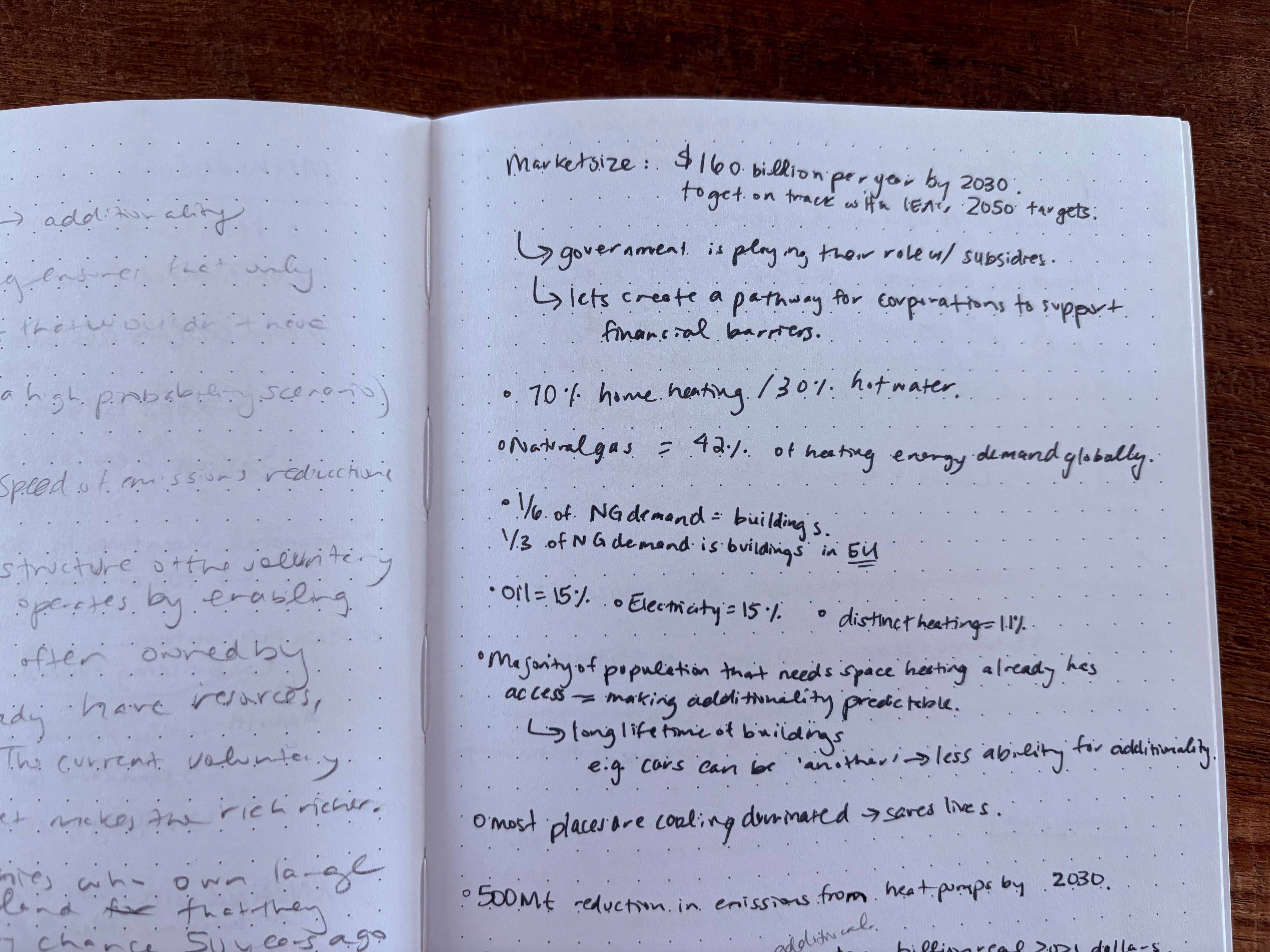
That slow stretch gave me the space, and eventually the nerve, to jump. I knew the problem inside out. I had the expertise. With enough hard work, I genuinely believed I could build the registry I wanted to see in the world, and build it only for buildings, so every part of it could be designed to get money into decarbonization projects as smoothly as possible.
Next, I needed people to come with me. So I went to every conference I could.
At first, I stumbled. I was pitching a company that existed mostly in a notebook and in my head, which is a strange thing to stand behind with a name tag on. But with mentors, warm introductions and a lot of repetition, the idea started to land. Verifiers liked that we hire and pay them ourselves instead of the project developer doing it, which removes an obvious conflict of interest. Building retrofit engineers reviewed our methodology and helped shape it. And people across real estate kept telling me the same thing: the technology wasn’t what was holding them back. The money was.
Bit by bit, the vision in that notebook became an impact company.
You might be wondering: why not leave the financial incentives to governments?
I spent enough time in government to know how long good regulation takes, and how often it swings back and forth once it’s in place. Buildings don’t have that kind of time. We need these incentives now.
Markets can move faster. We live in a world of markets whether we like it or not, and they work when you connect someone willing to pay with someone ready to deliver, even on opposite sides of the world. In all my years in climate work, I haven’t found a more provable way to speed up the energy transition than getting carbon finance into building retrofits. There was a gap, and I happened to have the experience to fill it.
So beyond certification, we built the Ontoly Portal, which matches buyers of high-quality carbon credits with qualified building retrofits.
Three things we’re proudest of:
We rate how much each project actually needs the money. We run a net present value analysis on every project, building by building, and score it from 1 to 5. A 5 means that even after grants, rebates and energy savings, the retrofit would take ten years or more to pay for itself. Carbon finance should go where it’s needed most.
We issue credits on real utility bills, not models. We look at up to three years of a building’s utility data before the retrofit and every year after, across a ten-year crediting period. If the reductions don’t show up in the measured data, no credits are issued. It really is that simple.
We certify one building at a time. Not from 10,000 feet. You know who owns the building, exactly what was installed, and exactly how its performance changed.
The technical details live in our Building Emissions Reduction Standard (BERS)™.
The point of all this granularity is trust. I’m the kind of person who wants receipts. In our case, literally: utility bills. We designed everything around the questions we’d ask if we were the ones buying, especially the big one: does this project really need the money? (We go deeper on how we answer it in how we measure additionality and what a building retrofit tonne actually costs.) And if someone asks you what your money actually did, you should be able to answer in one sentence. With us, you can: here’s the building, here’s what was installed, here are the bills.
If you’re a buyer, there are two ways in. You can get in early by reserving credits through a pre-purchase agreement, which helps fund the heat pump before it’s even ordered. That’s exactly when money tips the decision. If the project doesn’t go ahead, the reservation is cancelled and no money or credits change hands. Or you can buy issued credits in any quantity. Because we only issue on measured data, a new batch of verified credits comes up for sale every six months.
The people who choose Ontoly want to fund change they can point to: a specific building, specific equipment, a measurable drop on the bill. They’re willing to pay for proof. If you’ve read this far, maybe that sounds like you.
It’s taken a lot to get here. We’ve built the Ontoly Portal, where building owners upload their projects, we issue Building Emissions Reduction Unit (BERU)™ credits, and you can track every credit from purchase to retirement (the moment it’s used and can never be sold again). We’ve built a certification framework designed to hold up under scrutiny, and applied to have it assessed against the ICVCM’s Core Carbon Principles and for CORSIA eligibility. And we have a team ready to onboard projects. I’m proud of all of it, and of the people and partners who’ve come along. Now we’re scaling pilots, projects and buyers, and we’d love for you to join us.
Our vision is to speed up the transition to a world where every building runs on clean energy.
Is that a big, audacious goal? Yes. On purpose. The alternative is rolling over and accepting our fate, and that fate isn’t abstract: roughly 3.3 to 3.6 billion people already live in places highly vulnerable to climate change.[12] Every year we wait makes things harder for them. Accepting that feels neither ambitious nor practical. I’d rather try. Maybe you would too.
I’m an eternal optimist and a believer in markets, which I realize is two kinds of optimism.
I started Ontoly because I want to cut emissions as fast as we can. Carbon removal matters, and we’ll need it. But removal on its own won’t retrofit the buildings we live and work in. Somebody has to pay to swap out the boilers.
If my story or our mission resonates, or you think there’s a reason for us to work together, please reach out. I’d love to hear from you.
Buy credits. It’s the most meaningful way to support us. Open a free buyer portal account and back the projects that match your values. Not ready to buy yet? Totally fair. Open the account anyway and watch projects come through the pipeline. No commitment, just a front-row seat.
Own or manage buildings? We can help you get carbon finance for your building decarbonization project. Join one of our free webinars or read our Get Started documentation. We’ve made intake as painless as we can.
Spread the word. Share this post with anyone who could use building carbon finance or credible carbon credits.
Join the newsletter. Every few weeks, free, under five minutes. Real buildings and the people retrofitting them, carbon markets in plain words (we’ll warn you before any jargon), and just enough humour that the climate doom doesn’t settle into your bones. Choose the Owner Edition or the Buyer Edition. There’s a real person on the other end.
Thanks for reading my story. I truly believe we’ve built something that can leave the world a little better than we found it. I’d love for you to be part of it.
See you out there,
Ashley Sarauer
Founder & CEO, Ontoly | Squamish, BC
[1] UN Environment Programme and Global Alliance for Buildings and Construction (2026). Global Status Report for Buildings and Construction 2025–2026. https://www.unep.org/resources/report/global-status-report-buildings-and-construction-2025-2026
[2] International Energy Agency (2021). Net Zero by 2050: A Roadmap for the Global Energy Sector. https://www.iea.org/reports/net-zero-by-2050
[3] International Energy Agency (2022). Is the energy crisis really making the business case for heat pumps? https://www.iea.org/reports/is-the-energy-crisis-really-making-the-business-case-for-heat-pumps
[4] International Energy Agency (2023). Net Zero Roadmap, 2023 update: Space heating. https://www.iea.org/reports/space-heating
[5] CarbonCredits.com (2025). Biochar Carbon Credits in 2025: Stable Prices Amid Weakening Demand (citing S&P Global price assessments). https://carboncredits.com/?p=39628
[6] City of Boston. Take action if your building may be out of compliance with BERDO (Alternative Compliance Payments). https://www.boston.gov/news/take-action-if-your-building-may-be-out-compliance-berdo
[7] American Bar Association. NYC’s Local Law 97 Sets GHG Emissions Limits for Its Buildings’ Sustainable Future. https://www.americanbar.org/groups/environment_energy_resources/resources/newsletters/environmental-social-governance-sustainability/nycs-local-law-97-sets-ghg-emissions-limits/
[8] Government of Alberta. Technology Innovation and Emissions Reduction Regulation. https://www.alberta.ca/technology-innovation-and-emissions-reduction-regulation
[9] Mass Save. Case study: Hassan Apartments (100-unit building; in-window heat pumps replacing electric baseboard heat). https://www.masssave.com/case-studies/hassan-apartments
[10] The Shrewsbury and Telford Hospital NHS Trust (2025). Royal Shrewsbury Hospital breaks ground on major decarbonisation project. https://www.sath.nhs.uk/news/royal-shrewsbury-hospital-breaks-ground-on-major-decarbonisation-project/
[11] Fowlie, M., Greenstone, M. and Wolfram, C. (2018). Do Energy Efficiency Investments Deliver? Evidence from the Weatherization Assistance Program. Quarterly Journal of Economics 133(3). Working paper version: NBER w21331. https://www.nber.org/papers/w21331
[12] IPCC (2022). Climate Change 2022: Impacts, Adaptation and Vulnerability. Working Group II contribution to the Sixth Assessment Report, Summary for Policymakers. https://www.ipcc.ch/report/ar6/wg2/